
Honey, I Blew Up the Ants!
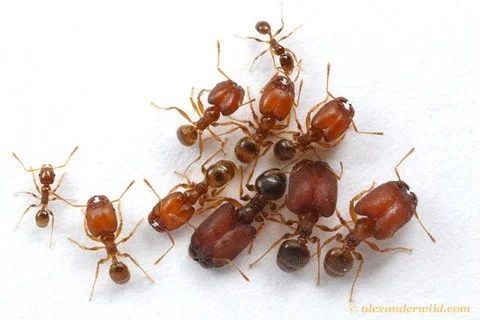
Workers, soldiers and supersoldiers mingle in this ant colony. Photo by Alex Wild at alexanderwild.com.
A hidden evolutionary potential, millions of years in the making.
While collecting ants on Long Island, Ehab Abouheif and his team discovered several unusually large ants that resembled the rare "supersoldier" ants normally found only in the American Southwest. Although the specimens died before they could be fully studied, the unexpected discovery sparked years of research into how these remarkable ants develop.
Five years later, the team found that ordinary Pheidole ants could be induced to develop into supersoldiers by applying a hormone during a precise window of larval development. They were able to produce supersoldiers in every species they tested—even species not known to naturally produce them—revealing that the potential had remained hidden since a common ancestor.
The findings showed that ancestral developmental potential can remain dormant for millions of years and be reactivated under the right conditions. This work provides new insight into how developmental systems function, how the environment influences evolution, and how hidden traits can become the raw material for evolutionary change.

About the Abouheif Lab
The Abouheif Lab combines ecology, evolution, and developmental biology to explore how living systems become more complex — and what happens when those systems break down. By studying these connections in nature, the lab aims to develop innovative ideas that can help address challenges ranging from cancer to climate change.
